Green Camouflage Seamless Pattern: A Practical Guide for Designers and Creators
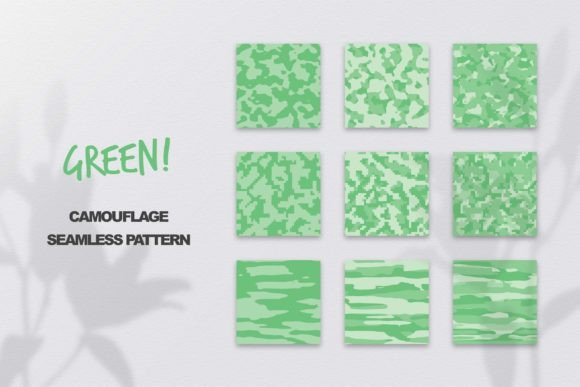
A Green Camouflage Seamless Pattern is a vector-based, tileable design that replicates the visual language of military or nature-inspired camouflage—using organic shapes, layered tones of olive, khaki, forest green, and charcoal—but engineered to repeat infinitely without visible seams. Unlike raster-based textures or photographic overlays, this pattern is built entirely in vector format, meaning it scales flawlessly across any size or resolution, from business card backgrounds to billboard graphics.
What Makes This Green Camouflage Seamless Pattern Distinct?
The version described—delivered as 1 EPS CC file containing all patterns—stands out for three core reasons: seamlessness, vector fidelity, and intentional simplicity. Each pattern repeats edge-to-edge with mathematical precision; no manual alignment or tiling adjustments are needed. Because every element is 100% vector (not traced or raster-converted), users retain full editability: individual shapes can be recolored, repositioned, or isolated without quality loss. And unlike multi-layered PSD packs or complex AI files with embedded effects, this EPS file prioritizes clean construction—making it compatible across Adobe Illustrator CC versions and easily importable into CorelDRAW, Affinity Designer, or InDesign for layout work.
Seamless ≠ Automatic — Why That Matters
Not all “seamless” patterns behave the same way. Some rely on subtle blurring or opacity tricks at tile boundaries, which break down when scaled or recolored. Others use high-resolution raster tiles that pixelate when enlarged beyond their native dimensions. A true Green Camouflage Seamless Pattern avoids those compromises by using path-based geometry and precise anchor placement—ensuring continuity whether used at 24px for an icon background or 2400px for a fabric mockup. This reliability matters most in production environments where consistency across assets is non-negotiable.
How It Compares With Other Camo Resources
When evaluating options, designers often weigh four practical dimensions: scalability, editability, integration workflow, and visual authenticity.
- Raster camouflage textures (e.g., JPEG or PNG tile sets) offer rich detail and realistic grain but lose clarity when scaled beyond original dimensions. They’re suitable for web UIs or quick mockups—but impractical for print or branding systems requiring multiple sizes.
- Photographic camo overlays introduce lighting, depth, and surface variation, which add realism but limit flexibility. Adjusting color balance or isolating elements requires masking or layer separation—adding time and complexity.
- Hand-drawn or brush-based camo vectors provide artistic character but often lack true seamlessness or uniform density. Repeating them cleanly usually demands manual tweaking per tile.
- This Green Camouflage Seamless Pattern, by contrast, balances technical precision with stylistic cohesion—offering consistent tone distribution, predictable spacing, and immediate usability across platforms.
Tradeoffs to Consider
No single pattern suits every need. The strengths of this Green Camouflage Seamless Pattern come with natural tradeoffs:
- Visual restraint: It avoids photorealism or texture noise, making it less ideal for hyper-realistic product renders or lifestyle photography composites.
- Style specificity: Its palette leans toward earthy, muted greens—not neon, pastel, or monochrome variants. Users seeking broader tonal ranges would need supplementary assets.
- Format limitation: Being EPS-only means no native support for variable fonts, SVG interactivity, or CSS background-repeat optimization without conversion. Those workflows require additional export steps.
Where This Pattern Fits Best
This Green Camouflage Seamless Pattern excels in contexts where clarity, adaptability, and professional polish matter more than atmospheric nuance. Real-world applications include:
- Branding and identity systems—used as a subtle background element in presentation decks, report covers, or stationery, where legibility and scalability are essential.
- Apparel and textile prototyping—applied to garment flats or fabric swatches in design software, enabling fast iteration without pixelation or tiling artifacts.
- UI component backgrounds—scaled down for dashboard tiles, badge icons, or section dividers where a low-contrast, organic texture adds visual interest without distraction.
- Educational or technical illustrations—as a neutral yet thematic backdrop for diagrams, infographics, or training materials related to outdoor, defense, or environmental topics.
When You Might Choose Something Else
Consider alternatives if your project calls for:
- Dynamic responsiveness: For websites or apps needing adaptive backgrounds that shift with screen size or user interaction, an SVG-based pattern with CSS control may offer more flexibility than static EPS.
- Multilayered realism: If you’re creating packaging mockups with embossing, foil stamping, or fabric weave simulation, a layered PSD or multi-channel TIFF resource gives greater control over depth and lighting.
- Broad stylistic variety: When developing a brand system requiring coordinated camo variants (e.g., desert tan, urban grey, digital pixel), a bundle with multiple palettes and densities may better serve long-term needs than a single green-focused set.
- Non-Adobe workflows: Teams relying exclusively on Figma, Sketch, or open-source tools may find direct EPS integration cumbersome—and benefit more from SVG exports or plugin-compatible libraries.
Practical Integration Tips
Because this Green Camouflage Seamless Pattern arrives as a single EPS CC file with all patterns included, users can maximize utility with a few straightforward steps:
- Open the file in Illustrator and use the Swatches panel to drag individual patterns directly into your document’s swatch library—no copying or pasting required.
- Apply patterns to objects via Fill, then adjust scale using the Transform effect (Object > Transform > Scale) rather than resizing the object itself—preserving crisp edges.
- To customize color, select the pattern fill in the Appearance panel and use Recolor Artwork to shift hues while maintaining relative tonal relationships.
- For print output, verify that overprint settings are disabled unless intentionally simulating ink layering—vector patterns render predictably but still follow standard CMYK or spot-color rules.
Making an Informed Choice
Choosing a Green Camouflage Seamless Pattern isn’t about finding the “best” camo—it’s about matching technical attributes to real-world constraints. Ask yourself: Do I need infinite scalability? Will this be used across both digital and physical outputs? Is editability more valuable than photorealism? Does my team have access to Illustrator CC—or do we rely on cross-platform tools?
If your answer leans toward precision, consistency, and vector-native flexibility—and your use case falls within branding, apparel design, or structured digital interfaces—this pattern delivers measurable efficiency. It reduces trial-and-error, eliminates scaling guesswork, and supports thoughtful iteration without sacrificing quality. But if your goals center on tactile realism, rapid web deployment, or broad stylistic coverage, pairing it with complementary resources—or selecting a different format altogether—may better align with your actual workflow.
As with any design asset, context determines value. A Green Camouflage Seamless Pattern isn’t a universal solution—but in the right situation, it’s a quietly effective tool that earns its place in a professional toolkit.